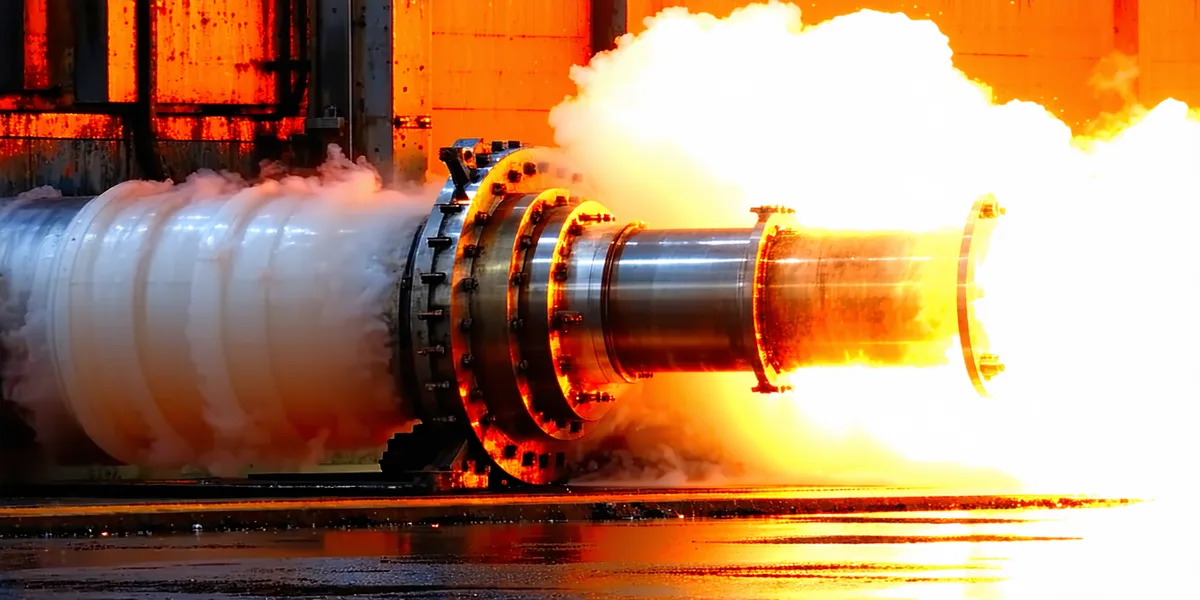
ISPTech has completed the engineering qualification of the CHT-20B, a 20 N bipropellant thruster that extends the company's chemical propulsion family into the GEO transfer and high-delta-V apogee manoeuvre segment. Qualification testing was completed at Lampoldshausen in October 2024, and the programme is now open to customer enquiries.
Background: Why a 20 N Bipropellant Variant
ISPTech's existing chemical thruster family addressed the 0.5–10 N thrust range, covering station-keeping, fine attitude control, and orbit maintenance for LEO and MEO missions. As ISPTech engaged with satellite OEM customers during 2023 and early 2024, a clear pattern emerged in requirements discussions: several programmes targeting GEO transfer from a low-energy injection orbit — typically via a launcher upper stage that deposits the satellite into a supersynchronous transfer orbit — required significantly higher thrust-to-mass ratios for the apogee kick manoeuvre than ISPTech's existing family could provide without clustering multiple thrusters.
Clustering 5N or 10N units introduces plumbing complexity, propellant management constraints, and propulsion module mass penalties that satellite bus architects prefer to avoid. A single 20 N bipropellant thruster, combined with an appropriate propellant management unit, offers a cleaner integration path. This is not a novel insight in spacecraft propulsion — the 20–22 N class has been a standard slot in European propulsion catalogues for GEO platforms for over two decades. The question for ISPTech was whether a propulsion system at this thrust level could be packaged to meet the mass and volume constraints of mid-size GEO satellites (1,000–3,500 kg wet mass), while delivering specific impulse performance competitive with heritage systems.
CHT-20B Design Approach
The CHT-20B operates on a standard nitrogen tetroxide (NTO) / monomethylhydrazine (MMH) bipropellant combination, with a nominal mixture ratio of 1.65 (NTO/MMH by mass). Chamber pressure is 8.3 bar, and the expansion ratio is 100:1, targeting a vacuum specific impulse of 292–295 s. This Isp range is consistent with industry-standard 20 N bipropellant thrusters operating under similar chamber conditions, and positions the CHT-20B competitively for the apogee kick role without requiring exotic materials or manufacturing processes.
The combustion chamber and nozzle are manufactured from a high-temperature nickel-base superalloy, with a platinum-iridium catalyst bed retained for improved ignition reliability during long coast phases. The valve assembly uses the same solenoid valve architecture as ISPTech's lower-thrust chemical family, reducing qualification risk and commonality of spares across the product line. Dry mass of the qualification model was 345 g, within the ±10% allocation agreed with the reference satellite bus in the requirements phase.
Qualification Test Campaign
The qualification programme was structured to ECSS-E-ST-35-06 Level 2 requirements, the applicable European standard for chemical propulsion subsystem qualification. The following test sequence was executed on the Qualification Model at ISPTech's hotfire test rig at Lampoldshausen:
- Cold flow and propellant conditioning: valve leak, flow coefficient (Cd) measurement at nominal and dispersed inlet pressures (9–16 bar feed)
- Ignition characterisation: 50 ignition events across the temperature range −10 °C to +50 °C propellant temperature, mapping ignition delay distribution
- Steady-state performance: thrust, specific impulse, and mixture ratio measurements across the full inlet pressure envelope; plume diagnostics for thermal load mapping
- Minimum impulse bit: 30 ms pulse width characterisation for attitude control authority validation
- Life test: 3,000 pulse cycles (200 s cumulative firing duration) representative of 15-year GEO station-keeping plus transfer firing duty
- Structural qualification: random vibration and sine burst per ECSS-E-ST-10-03, combined with thermal vacuum cycling (−40 °C / +120 °C, 50 cycles)
Post-campaign hardware inspection included dimensional measurement of the throat area, catalyst bed mass retention, and valve seat microscopy. Throat erosion measured 0.3% area increase over the cumulative firing duration — within the ±2% allowable erosion band used in performance margin calculations for GEO lifetime assessments.
Performance Results and Margins
Measured vacuum Isp at nominal operating point was 293.4 s, against a requirement of ≥290 s. Thrust at nominal inlet pressure was 20.6 N (requirement: 20 N ±5%). Ignition delay across the full temperature range was 28–42 ms — the upper end of this range occurs at cold-soak conditions near −10 °C propellant temperature, which mission planners should account for in manoeuvre sequence timing when operating following a long eclipse.
It is worth noting that specific impulse values quoted for bipropellant thrusters are sensitive to the actual mixture ratio achieved in flight, which depends on propellant management system pressure regulation accuracy. The 293.4 s figure reflects the test facility's feed system regulation; satellite-level Isp will vary by ±1–2 s depending on propellant management unit regulation precision. ISPTech recommends customers model this variation in delta-V budget calculations rather than treating the nominal Isp as a fixed point value.
Propellant Management Compatibility
The CHT-20B is compatible with ISPTech's PMU-GEO propellant management unit, which was designed to support the 20 N thrust class. The PMU-GEO provides regulated feed pressure to both the oxidiser and fuel paths via independent pressure regulators, with latch valve isolation on each path and a common pressurant supply from a separate high-pressure GHe vessel. This architecture is appropriate for the blowdown-to-regulated transition commonly used in GEO transfer missions, where the propellant management system begins transfer in blowdown mode and transitions to pressure-regulated operation for station-keeping manoeuvres.
Customer Qualification Access
The CHT-20B qualification test report (QTR) is available to customers under a non-disclosure agreement, covering all test data, performance curves, and margin analysis from the qualification campaign. Flight unit acceptance testing is performed against acceptance test criteria derived directly from the qualification baseline, including thrust, Isp, leak rate, and ignition delay checks.
ISPTech's applications engineering team is available to support mission-level integration planning, including propellant budget analysis, thermal interface requirements, and export documentation assessment for customers requiring technology transfer authorisation. Requests can be submitted through the standard RFQ process.