Electric Propulsion Systems
Hall-effect and gridded-ion thrusters for high-efficiency orbit raising, station-keeping, and deep-space applications. Isp from 800 to 3,200 s.
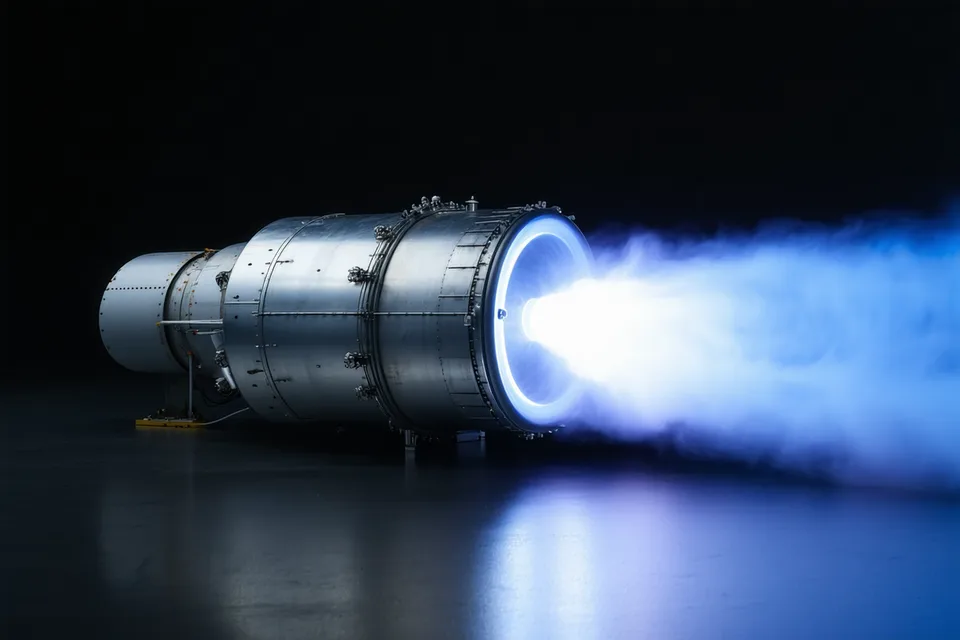
HET-200 Hall Thruster
| Parameter | Value |
|---|---|
| Discharge Power | 100 – 500 W |
| Thrust (nominal 300 W) | 18 mN |
| Specific Impulse | 1,400 – 1,800 s |
| Total Efficiency | 48 – 56 % |
| Propellant | Xenon (Xe) |
| Xenon flow rate | 0.85 – 1.8 mg/s |
| Beam divergence | < 45° half-angle |
| Mass (thruster head) | 0.55 kg |
| Parameter | Value |
|---|---|
| Anode Voltage | 200 – 350 V |
| Cathode Type | Barium-oxide emitter |
| Magnetic Field | ~200 G (peak) |
| Operating Temp. | -30 °C to +80 °C |
| Lifetime | > 4,000 h (qualification target) |
| Interface | RS-422 + CAN |
| Qualification | ECSS-E-ST-35C |
| Heritage | 2 flight programmes |
Hall-Effect Thruster Principle
Typical Mission Applications
LEO Station-Keeping
Atmospheric drag compensation for low Earth orbit platforms at 350–500 km altitude. HET-200 provides efficient continuous thrust budget.
Orbit Raising
Transfer from injection orbit to operational orbit. Xenon propellant efficiency reduces launch mass by 30–50% compared to chemical systems for equivalent delta-v.
End-of-Life Deorbit
Active deorbit manoeuvres for LEO compliance with IADC debris guidelines and ESA Space Environment Requirements.
Deep-Space Cruise
High-Isp configurations for extended mission durations with low continuous thrust levels. ISP-HET-1500 variant under development.
Other Product Families
Request Electric Propulsion Datasheet
Performance maps, plume characterisation data, and PPU interface specifications available on request.